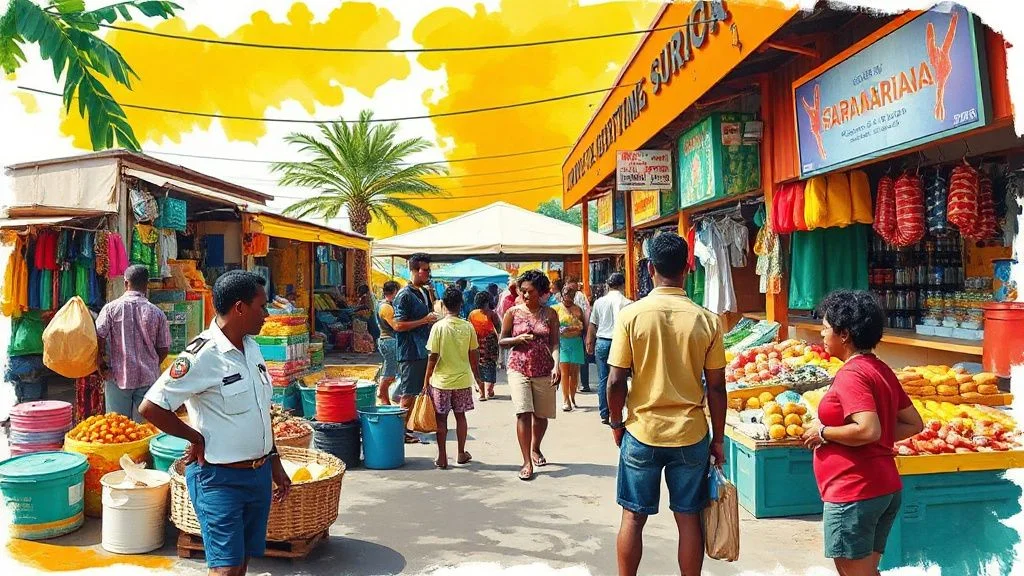

"Which account do you actually need?" has a short answer that follows from the law rather than from banking convenience: you need the SRD one. Everything you pay for locally is supposed to be priced and paid in Surinamese dollars. A foreign-currency account is for holding and receiving, not for paying — and it carries a paperwork cost at every deposit that nobody mentions.
Paying in dollars is not a convenience question
Guides treat "they take dollars" as a handy fact. Under Surinamese law it is not a neutral option. The Wet Controle Valutaverkeer en Transactiekantoren (23 March 2020, S.B. 2020 no. 73) provides in article 3 that:
- paragraph 1 prohibits transactions of any kind in cash in a currency other than the Surinamese dollar;
- paragraph 5 prohibits stating prices of goods or services in another currency;
- paragraph 6 prohibits advertising prices in another currency;
- paragraph 7 provides that for all money transactions the rate applies zoals die bij beschikking van de Bank is vastgesteld — as established by decision of the Central Bank.
So a merchant who prices you in dollars is doing what paragraph 5 forbids. The reason you still see it is that in case AR 20-1077 of 13 August 2020 the court forbade the State from applying paragraphs 1, 2, 5 and 6, along with article 5 paragraph 4, article 7 paragraphs 2 to 4, and the penalty provisions in articles 9 and 10 — and no ruling on the merits could be found as of 24 October 2026.
Unsettled is not the same as permitted. Treat a foreign-currency price as something to convert and pay in SRD, not as a feature.
Why a foreign-currency account costs paperwork
Article 4 paragraph 5 prohibits banks from accepting foreign currency for deposit without a verklaring van herkomst van de middelen — a declaration of the source of the funds. The Bank may set a minimum amount below which this does not apply.
This paragraph was not suspended. So every time foreign currency goes into that account, the origin question comes with it. That is not a reason to avoid such an account; it is a reason to keep the evidence — payslips, the sale of a property, the statement of the account it came from — filed with each deposit rather than reconstructed a year later.
And the other side of the counter: article 5 paragraph 4 restricted banks from selling foreign currency to individuals except for maintenance obligations, travel, study, medical purposes and of voor de aanzuivering van credit cards. That restriction is among the suspended provisions — so the rule a guide would cite as "you can only buy dollars for certain reasons" is precisely the one the State was forbidden to apply.
What each account is actually for
- SRD: everything local. Rent where it is lawfully priced, utilities, groceries, school fees, government fees — the Hoofdafdeling Vreemdelingenzaken, for instance, takes its fees in SRD at the Central Bank's rate.
- EUR or USD: receiving income or savings from abroad, and holding a balance you do not want converted twice. Each deposit brings the origin declaration with it.
- Both, if your income arrives in one currency and your costs fall in another. That is the honest case for two accounts — not protection from devaluation, which nobody can promise you.
The numbers we will not give you
Withdrawal limits and card surcharges are commercial terms, set per bank and per merchant, and there is no published schedule of either. Figures circulate — a daily cash limit around SRD 20,000, a card surcharge around five per cent — and we could not trace a single one to a source. They are not in this article.
Ask instead, and ask in writing: your own bank for its daily and per-transaction limits abroad and its foreign-transaction fee; the merchant, before the card goes in, whether a surcharge applies and how much. Both answers are specific to you and free to obtain, and both change without anyone updating a guide.
We also give no exchange rate. Article 3 paragraph 7 points at one rate — the Central Bank's — and we could not read it: the Bank's website refused requests from our server with an HTTP 403 on 24 October 2026. Take it from the Bank's own publication on the day that matters.
What expats should know
- The SRD account is the one you cannot do without.
- A foreign-currency deposit needs a declaration of origin under article 4 paragraph 5, which was not suspended. File the evidence per deposit.
- Ask your bank whether a minimum has been set below which the declaration is not required.
- Do not hold foreign currency as a forecast. Hold it because that is the currency your money arrives in or leaves in.
- Paying locally in dollars is not a convenience — article 3 paragraphs 1 and 5 address exactly that.
- Government fees are quoted in USD but paid in SRD at the Bank's rate on the day, so a fixed SRD figure for them is always wrong.
Where to check
The provisions are in the Wet Controle Valutaverkeer en Transactiekantoren, S.B. 2020 no. 73 and the suspension in AR 20-1077 of 13 August 2020. The Central Bank's move to a flexible exchange rate system on 7 June 2021 is recorded in CEMLA's macrofinancial notes. All read on 24 October 2026. For the applicable rate and the quarterly foreign-currency reporting, the Centrale Bank van Suriname's own publication is the source.
AI-Generated Content: This article was created with AI assistance and may contain inaccuracies. Please verify important information with official sources.