
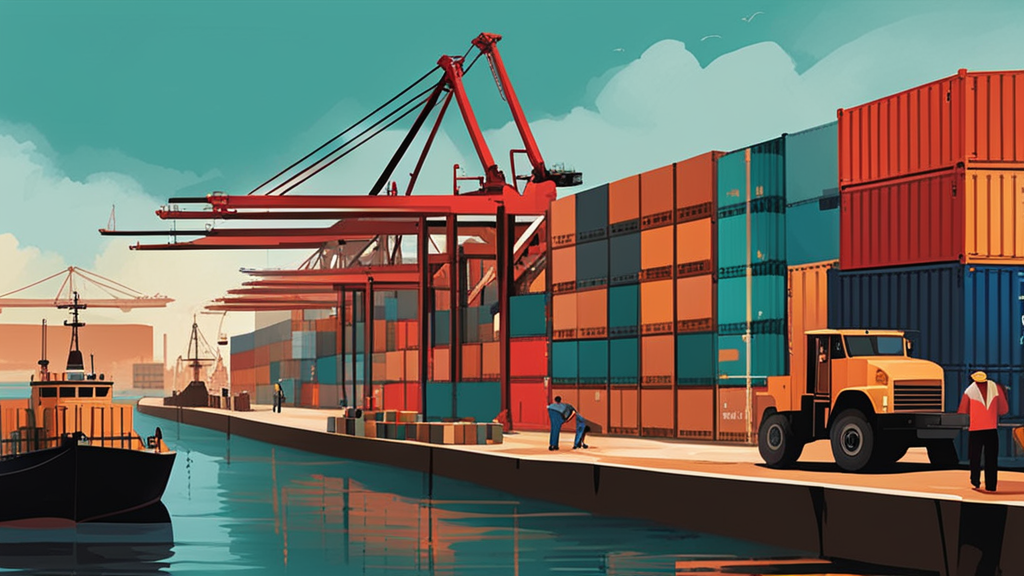
A container arriving in Paramaribo generates an invoice with more lines on it than the freight you agreed. This article explains what each of those lines is, which ones are negotiable, and which question to ask about each. It contains no amounts, and the reason is given below rather than buried: no published tariff was reachable.
Why there are no figures here
Checked on 24 October 2026: the terminal operator's own domains did not resolve, and the website of the port authority, N.V. Havenbeheer Suriname, returned a 504 Gateway Time-out. A search turned up no published Surinamese terminal tariff — only general explanations of terminal handling charges from freight industry sites.
So this article will not print a figure. Guides that do are quoting one another, and a budget built on a number nobody can source is worse than no number at all: it feels settled. Get a written, itemised quotation from your forwarder — the questions below are what to put in that request.
Terminal handling charges (THC)
THC covers the physical and administrative work of moving a container through a terminal: taking it off the truck or the ship, stacking it in the yard, and handing it over at the other end. It is normally split by which end of the journey it happened at — origin terminal handling at the port of loading, and destination terminal handling at the port of discharge.
The question to ask: which end am I being billed for, and is the other end already inside the freight rate I agreed? Being charged at both ends by two different parties for the same leg is the error worth looking for.
The ISPS security charge, and what the Code does not say
The International Ship and Port Facility Security Code sits under SOLAS chapter XI-2 and entered into force on 1 July 2004. It obliges governments, ships and port facilities to put security measures in place, and those measures cost money, which is why an ISPS line appears on shipping invoices worldwide.
Here is the part that matters when you read your invoice. The IMO does not state who bears the cost of port facility security. The Code sets the obligation, not the price. An ISPS charge is therefore a commercial tariff set by the terminal or the carrier, not a fee fixed by an international rule — which is exactly the opposite of how it is usually presented when queried.
The question to ask: is this a flat charge or calculated per container, and who sets it — the terminal or the shipping line?
Gate, documentation and the rest of the lines
- Gate charges arise when a container passes in or out of the terminal perimeter. Ask how many gate movements your shipment is expected to involve, because each one is billable.
- Documentation charges cover preparing and processing the bill of lading, customs paperwork and release documents. Ask whether the release document is included, since that is the one that holds up collection.
- Container maintenance or damage is billed when a container needs repair beyond fair wear. Inspect the container at handover, photograph it, and report damage in writing immediately — a dispute without a dated photograph is not a dispute.
- Demurrage and storage are the charges that actually surprise people. They start when the free days run out, and they accrue daily. Ask how many free days you have and from which date they are counted — the discharge date, the customs release date and the date you were notified are three different days, and which one starts the clock decides the bill.
Which charges are even yours: the sale term decides
Whether origin or destination charges fall to you is not a property of the port. It follows from the Incoterms rule in your contract — the trade terms published by the International Chamber of Commerce — which allocates cost and risk between seller and buyer at a defined point in the journey.
The question to ask before you compare two quotations: which Incoterm does each one assume? Two quotations on different terms are not comparable, and the cheaper-looking one is often the one that leaves destination charges with you.
The currency on the invoice is a legal question in Suriname
If your invoice is denominated in US dollars or euros, that is not a neutral choice. Article 3 paragraphs 5 and 6 of Suriname's Wet Controle Valutaverkeer en Transactiekantoren (23 March 2020) prohibit stating or advertising prices of goods or services in a currency other than the Surinamese dollar, and paragraph 1 prohibits cash transactions in another currency. Paragraph 7 provides that the Central Bank's published rate applies to money transactions.
In summary proceedings on 13 August 2020 (case AR 20-1077) the court forbade the State from applying paragraphs 1, 2, 5 and 6 until a ruling on the merits, and no such ruling could be found as of 24 October 2026. That is why foreign-currency invoices circulate despite the text of the Act.
The question to ask: which currency is the invoice in, and which rate on which date converts it? Name the rate source in writing. An invoice converted at a house rate rather than the Central Bank's published rate is a cost you did not agree to.
What expats should know
- Ask for an itemised quotation in writing before booking. Every line in this article should appear in it, or be confirmed as not applicable.
- Free days and their start date are the single most expensive detail. Get both in writing.
- An ISPS charge is commercial, not a rate the ISPS Code fixes.
- Check the Incoterm before comparing prices. It decides which half of the charges is yours.
- Photograph the container at handover. Damage billing is contestable only with dated evidence.
- Agree the currency and the conversion rate, not just the amount.
- No published terminal tariff was reachable on 24 October 2026, so treat any figure you are quoted elsewhere as a quotation, not a tariff.
Where to check
The ISPS Code is described by the International Maritime Organization. The currency provisions are in the Wet Controle Valutaverkeer en Transactiekantoren, S.B. 2020 no. 73 and the order is AR 20-1077 of 13 August 2020. The port authority is N.V. Havenbeheer Suriname, whose site was unreachable on the date above; for a current tariff, ask the terminal operator or your forwarder directly and get it in writing.
AI-Generated Content: This article was created with AI assistance and may contain inaccuracies. Please verify important information with official sources.
Primary Sources
Last updated: October 2026