The question in the title has a published answer and an unpublished one, and most guides mix them up. What a permit does for your children is documented: there is a declaration for minor children with its own fee, and there is a registration step at the Centraal Bureau voor Burgerzaken with its own document list. What the school system asks of them is not documented anywhere we can read, so we are not going to describe it.
The permit item that is actually about children
The fee table of the Hoofdafdeling Vreemdelingenzaken, read on 24 October 2026, contains one entry aimed at minors: Verklaring Minderjarige kinderen, a declaration for minor children, at USD 10. It is the cheapest line on the table by a wide margin, and it is the line a family most often does not know exists. It sits among the permit types, not among the naturalization entries, and it is paid into the same bank accounts as the other permits.
The registration step is where a child's paperwork is checked
After the beschikking is issued, the published procedure sends you to the CBB wijkkantoor of your place of residence. For a first permit the list names the passport, the beschikking, the original birth certificate — with the translated version attached if it is in a language other than Dutch or English — and, if you are married, the marriage certificate. You have to report in person. For an extension it is the passport and the original beschikking.
For a child that means the birth certificate is the load-bearing document, and the translation requirement is the part that catches families out. If the certificate was issued in a language other than Dutch or English, the translated version has to be with it at the counter.
What the nationality act says about children, which is more than you would expect
Two provisions of the Wet op de Nationaliteit en het Ingezetenschap matter to a family planning a long stay. Article 10, paragraph 1, provides that the minor child of someone naturalised as a Surinamese national, born before that naturalisation, is also regarded as naturalised — on one condition: indien het op het moment van de naturalisatie woonplaats of hoofdverblijf in Suriname heeft, if at the moment of naturalisation it has its domicile or principal residence in Suriname. And across this act, domicile or principal residence means the place where a person is registered in the population or residence register. Registration is therefore not an administrative afterthought; it is the condition the provision turns on.
Article 5 points the other way, at the child's own future choice: a child born in Suriname who has had its domicile or principal residence in the country since birth becomes Surinamese by declaring that wish within one year of reaching the age of 18. The fee table prices that route — Verklaring Naturalisatie Optie achttienjarige, article 5 WNI — at SRD 200, and those naturalization fees are paid at the Belastingkantoor of the Ministerie van Financiën on the Sommelsdijkstraat rather than at a commercial bank.
What a permit does not do, and what we cannot tell you about schools
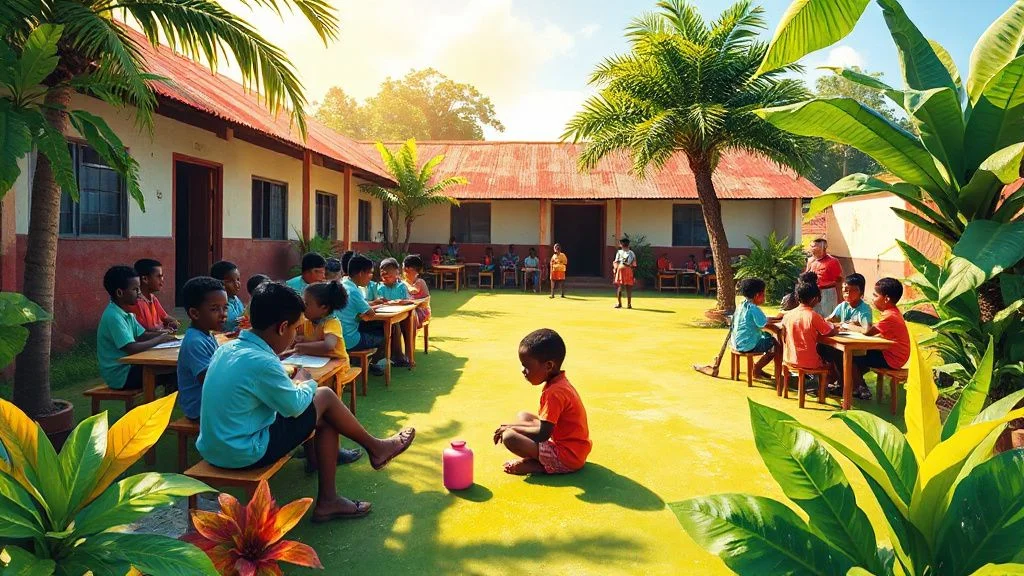
A residence permit is not a school admission. We found no published Surinamese source that sets out compulsory school ages, the structure of primary education, a national examination at the end of it, which schools charge fees, or how much. The ministry page we can read, checked on 24 October 2026, carries ministry news rather than any admission or fee information. So we are leaving all of it out: no ages, no number of years, no exam, no tuition figures.
That is a real gap and it is worth saying plainly, because it is the single thing a relocating parent most wants a number for. Ask the school directly, before you commit to a neighbourhood, and ask it in writing: which documents it wants for enrolment, whether it teaches in Dutch, what it charges per year, and what it does for a child who does not yet speak the language of instruction. Those four answers are specific to the school, and no general article can stand in for them.
The fees are set in US dollars, so a fixed SRD amount is wrong by construction
The Hoofdafdeling Vreemdelingenzaken publishes one table of application types and fees. Read on 24 October 2026, it sets residence (Surinamese origin as well as other foreign nationals) at USD 150, an extension at USD 150, residence for an indefinite period and settlement at USD 200, a duplicate at USD 250, and a declaration for minor children at USD 10. The four naturalization entries are set at SRD 200.
The detail that decides whether a guide is usable is the sentence underneath that table. The department writes that the fees for the various permit types are payable in SRD (de tegenwaarde van de officiële koers van de Centrale Bank van Suriname) — in Surinamese dollars, at the equivalent of the official Central Bank rate. The amount owed is therefore a dollar amount converted on the day you pay. Any guide that hands you a fixed SRD figure for these fees is wrong the moment the rate moves, and it was probably wrong when it was written. Take the USD figure to the bank and let the counter do the conversion.
The department also publishes that a refusal does not get your money back: Indien uw aanvraag wordt afgewezen zult u niet in aanmerking komen voor restitutie van de kosten/ leges. The deposit accounts it names are DSB Bank 184-4784 or 901-0904, Volks Crediet Bank 1225-60090, Landbouwbank 560-1340 and Hakrinbank 920-2536 — but the four naturalization fees go to the Belastingkantoor of the Ministerie van Financiën on the Sommelsdijkstraat instead, which is the kind of detail that costs a wasted morning.
The order that saves you a second trip
Settle the permit type with the department before you pay anything, because the fee follows the type and not your nationality. Ask whether the declaration for minor children applies to your family. Bring each child's original birth certificate, with a translation if it is not in Dutch or English. Expect to report in person at both the Vreemdelingendienst and the CBB, and expect each desk to keep what it asked for. Then start on the school, with the written questions above.
Sources: the FAQ of the Hoofdafdeling Vreemdelingenzaken, the consolidated text of the Wet op de Nationaliteit en het Ingezetenschap and the page of the Ministerie van Onderwijs, Wetenschap en Cultuur.
AI-Generated Content: This article was created with AI assistance and may contain inaccuracies. Please verify important information with official sources.